Thursday, September 3, 2015

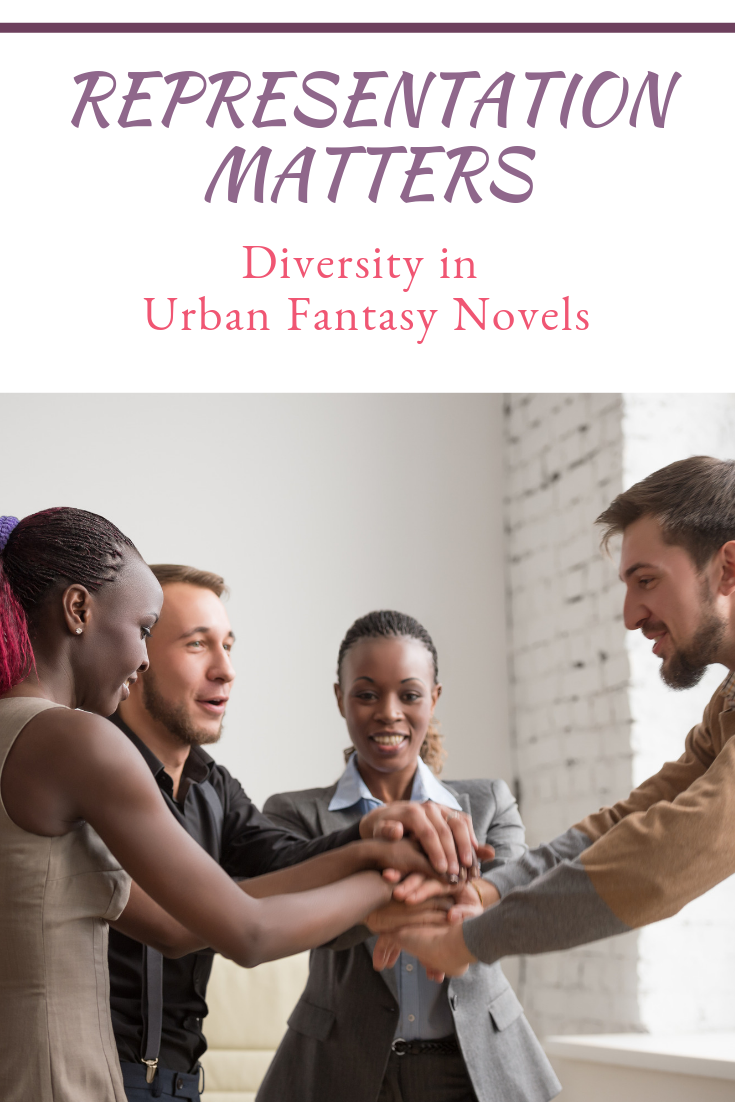
Representation matters

My first book, She Dies at the End, has more diverse characters than many paranormal or urban fantasy novels out there. So why did a white woman write a book full of people of color?

People of color are bombarded daily with the message from popular culture that white is normal and that everything and everyone else are not. That sends a harmful message to everyone, of any race. I didn't want my book to be part of that damaging narrative, so I have tried to create characters in which a variety if people can see themselves reflected.

If we're going for realism (well, realism in a world where vampires, fairies, and werewolves are real, anyway), my characters in She Dies at the End would not be living in an all-white world. My story is set largely in the San Francisco Bay Area. California is not majority white. Why would a story set here have only white people in it? Why would a vampire family assembled over many centuries across four continents consist solely of Europeans?

Then there is the fact that it is boring to live in a monochrome world, so why should people have to read about one? When I started my book, I was writing for fun. I made choices that made me happy. I wanted white, Black, Asian, Latino, and mixed characters. I wanted a cast of characters that made me think of Oakland in all its mixed up glory, that celebrated the city where I once taught high school and where I still go to church.

My son is half Black, half East Indian. He has an Indian dad and a white mom. Kids like him should see people they can identify with in pop culture. White kids also benefit from seeing people of color portrayed in a positive light. It combats all the negative stereotypes they see broadcast every day. It helps us all have empathy for people who look different from the way we look.

And don't tell me that talking about race makes me the real racist. That is bullshit. Ignoring race means ignoring part of who someone is and dismissing the lived experiences of people of color.

Did I do a perfect job realistically portraying my characters of color? Probably not. I did my best to use everything I have learned by listening to my friends and family of color, or by listening to strangers' stories online and off. I may well have made a hash of it, but at least I tried. That's more than a lot of much more successful authors can say.

Representation matters.

Monday, August 17, 2015

Tales from the sick bed

Over the last several years, writing has become an important and rewarding outlet for me.  It has taken an especially important place in my life due to the fact that for the last 15 years, I have been living with and trying to effectively manage a chronic illness.  I'd like to share some of the ways writing has enriched my life and helped me to compensate for some of the losses and limitations I experience, in the hopes that I might encourage some of my fellow members of the constantly sick club to take up the metaphorical pen.

Creative and intellectual fulfillment


I have a degree in chemistry.  I was a straight-A student.  Lupus makes it impossible for me to work a full time job without becoming dangerously and constantly ill. Many people with chronic conditions are in the same boat, and it can deal a terrible blow to one's self-esteem.  Writing, whether for publication or simply for oneself, can provide a sense of accomplishment that can make the difference between contentment and despair.  Sharing your writing can make an impact on the world around you and provide you with a new sense of purpose.  Even if you only reach a few people, those few people have richer, happier lives because of you and your work.  Moreover, many of us experience the "brain fog" common to the chronically ill.  Mental deterioration is especially common if your disease is neurological in nature.  Writing or other creative outlets can help keep the brain firing on all cylinders.

Flexible hours and work environment


Writers don't have a fixed schedule.  The work can be done any time of day and in almost any location.  You can write in bed.  You can do research in your doctor's waiting room.  You can brainstorm with an IV needle in one arm and a blood pressure cuff on the other.  You can set your own realistic deadlines, keeping in mind your strengths and your limitations.  Chronically ill people hate the perception that we are unreliable because we often have to cancel plans or make adjustments to schedules in order to manage our symptoms.  At least with writing, or other artistic pursuits, we don't have to worry so much about letting anyone down or pushing ourselves so hard that we pay for it later.

Escaping the house with your imagination


Being sick all the time can be incredibly boring.  Being stuck at home can be depressing.  Limitations posed by your condition can be infuriating.  But your characters can do everything you wish you could do and go anywhere you dream of going.  I will never be able to sunbathe on a beach, and I'm unlikely to run a marathon, but my mind has no such limitations.  Daydreaming is fun and stress reducing, and as a writer, you get to call it work.  

Easing loneliness


Isolation can be one of the most damaging aspects of chronic ailments.  Sharing your writing with your friends and family, or with the online world at large, can help you make connections.  The internet makes it easier to find people with whom you can share your thoughts as well as your art.  You don't have to write a novel.  You can share a poem or a short story.  You can blog about your favorite show, or book, or sports team, or hobby. You can write about the political or social issues of the day and discuss your views with the like-minded and not so like-minded.  It can be terrifying to put your work out into the world, just as it is scary to go to a party with a bunch of people you don't yet know.  I try to tell myself that nothing worth having comes without risk.


Trying to practice what I preach, my new adult paranormal fantasy novel She Dies at the End is now available fon Amazon Kindle.

Sunday, August 9, 2015

#BlackLivesMatter on the First Day of Kindergarten

One day he comes into the kitchen and tells you that the other kids wouldn't let him play their game and told him it was because he is the wrong color.  He is five years old.  And you think, Here we go.  Even before kindergarten, it begins.

All mothers are nervous before the start of Kindergarten.  I know this.  We are all concerned about mean teachers and mean children.  We fret that they won't eat their lunch or will have trouble making friends or will struggle with homework.  We are anxious that school will kill their curiosity and enthusiasm about learning.

But mothers of Black sons, and other sons of color, have extra worries you may never have considered.  Will he be excluded from games because of his race?  Will my child get blamed for something another child did because he is Black?  Will normal childhood behavior get him labeled as the bad kid when the same behavior in a white child would be tolerated?  Will he be expected to speak for his whole race whenever something about Black people comes up?  Will he have to sit through tone-deaf lesson plans and listen to teachers spout racist nonsense unaware of their own biases?  And these are just the threats to their hearts and souls.  There are also the threats to their bodies, from strangers who will make racist assumptions about them, perceive them as threats even before puberty.

The beginning of school is the start of their lives in an outside world where we cannot any longer protect them from those who will see them as stereotypes instead of as people.  Even before they can read or reliably tie their own shoes, Black children are more likely to be suspended or expelled than other students.  We know that Black boys are estimated to be much older than they actually are. That problem may have contributed to the murder by a police officer of a 12-year-old boy in Cleveland.  The world is simply more hostile for our sons, even the world of school, where they ought to be safe.

These are the realities that Black mothers have lived with forever.  The fact that white mothers of Black sons are starting to talk openly about such things shouldn't make people take it more seriously.  Sadly, perhaps it will, so here I am talking about it.

I am grateful that my son is extremely well-behaved in public and focused in preschool.  He is polite and friendly and endearing and happy and, for a few more years at least, very cute.  But I know that isn't enough to protect him.  Respectability is not enough to protect any of our sons, but we cling to it anyway, because it's better than nothing, because we know they'll have to work twice as hard as everyone else to get the respect they deserve. I am grateful to live in a part of the country that is no longer majority white, and in which overt racism is socially stigmatized.  I'm grateful that we chose a neighborhood in which the school is fairly diverse.  I'm grateful for our church community full of adults and older children of color who provide role models and advice when things happen.

I am also afraid.  I fear that I won't be there to defend him the first time someone calls him the N-word.  (I know we are lucky it hasn't happened yet.)  I fear that when he gets into an argument with a white student, it will automatically be the tall Black kid's fault.  I fear that my white privilege cannot protect him when he isn't holding my hand.  I fear that by the end of 5th grade he will be a scary Black man in the eyes of strangers.

But I am not paralyzed by my fear.  We prepare him as best we can.  We talk about racism.  We talk about what to do if someone calls him out of his name.  We talk about in the fact that he doesn't have to answer people's questions about his family if he doesn't want to, that he can decide how to tell his own story.  We talk about not wearing your hood up and how you talk to police, how you behave if you get pulled over.  We don't obsess over the dangers.  We don't teach him to be terrified of the whole world.  But we do speak honestly and openly about race and racism. He has already been excluded from games because of his color, after all. To deny that reality would damage him as much as the obnoxious children who excluded him, maybe more.

I am also not consumed by my fear.  I still talk with excitement with him about his new adventure.  I still stand grinning in the back-to-school section looking at lunch boxes.  I still get his wardrobe ready and hope for a good teacher and gossip with my mom friends about all the changes in store.  I still love that he loves his new backpack and insists on wearing it around the house.  But the worry is still in the back of my mind, even then.

Now, I know that some of you think I am borrowing trouble.  Some of you think this is a post-racial America, and racism is over, and talking about race makes me the real racist.  Some of you don't talk about race with your kids because you want them to be "colorblind." Refusing to discuss or acknowledge racism only allows it to perpetuate.  Perhaps if more white people would speak up, with their kids and with their friends, we wouldn't have to be so scared to see our sons growing older.

Racism isn't just hoods and burning crosses.  We are all products of a culture that teaches that white is best, and nobody grows up in a culture like that without being affected.  No power structure is immune from that influence, be it police department or church or school district or classroom.  So many people want to deny this reality, perhaps for fear of accepting blame. 

So we allow our world to continue to kill Black kids and then try to find a reason they had it coming.  He should have been more polite.  Why did she mouth off like that?  He shouldn't have run.  It's his parents' fault.  Look how trashy they are.  He should have gone straight home.  Never you mind that a white kid in the same situation would still be breathing.

And so mothers of Black sons are afraid sometimes, and we have to be brave, because that is the world into which we send our beloved sons on the first day of kindergarten: a world in which they are at the very bottom of the list of which lives matter.  


A.M. Manay is a writer and mother.  Her novel, She Dies at the Endis available on Amazon Kindle.  Follow her on twitter (@ammanay) or Facebook (facebook.com/ammanaywrites).


Tuesday, August 4, 2015

The Girlfriend's Guide for the New Lupus Patient

Getting diagnosed with a chronic illness can be overwhelming. Sometimes it can be a relief to have a name for what you're going through, especially if you've been suffering for a long time with no diagnosis or treatment. Even still, you are bombarded with information and decisions that need to be made, and it's a lot to handle. Here are some tips from someone over fifteen years down the road. The advice is specific to Lupus, but a lot of it would also apply to other chronic conditions or autoimmune disorders.


1) Find a doctor you trust.

Your rheumatologist (and his or her nurse) need to be good. You will hopefully be with her a long time. She needs to be someone with good judgment who takes your quality of life seriously. If your blood work looks okay but you feel like death, she needs to take that seriously. She should ideally have connections to other specialists you might need (dermatologist, nephrologist, perinatologist, etc.). She needs to be willing to get on the phone with your other doctors. She and her nurse need to be willing to battle the insurance company when they try to deny coverage for something you need. You need compassionate warriors. Don't accept less.

Obtaining the health care you need is infinitely easier, of course, if you have insurance, money, and reliable transportation. If you're lucky like me, thank your stars.  

If you are not so lucky, the programs meant to help those of us who don't have those advantages can be hard to access, but you must persevere. It isn't fair that you'll have to fight the bureaucracy, but your life depends on it. There are people who can help you, like disability attorneys and hospital social workers. Seek advice in Lupus groups from people who’ve successfully navigated it.


2) Stay out of the sun.

For real. If you are an outdoorsy person, and you wish to remain outdoorsy, you have to take a lot of precautions. It's not fair, but it's the truth. A large percentage of lupus patients get worse with UV exposure. That means hats. That means sunscreen every day, at least SPF 30. That means long sleeves. That mean minimizing your beach and pool time, buying bathing suits that cover you up, using umbrellas. It means maybe needing to wear gloves when you drive, or getting coatings on your windows. That mean no tanning bed ever, ever again. Ever. Like, you could die from that nonsense. That means take your vitamin D, 'cause you're sure as heck not making much yourself.  

The one good side to this is that you will look young for a long time. Your dermatologist will be super impressed, and you can giggle at everyone's crow's feet at your high school reunion.  I have not left the house by day without a hat on in 15 years. It shows.


3) Diet and supplements will help, but they aren't a cure.

Eating right can help your disease. It can definitely reduce inflammation. It can help you manage your weight, which will help your joints. It can help your energy. It may even help you reduce your medication intake. But the raw carrot diet is not going to stop your white blood cells from making auto-antibodies. You still need a doctor. You might still need medication. Don't pull a Steve Jobs and try to use your Google MD to try to cure a complex illness with veggies, especially if you have organ threatening disease or are pregnant.  

The most common supplements thought to be helpful for people like us are fish oil, turmeric, vitamin D, calcium, folic acid, and DHEA. Some of us take iron for anemia as well.  Ask your doctor before you do anything.

This leads us to . . .


4) Take your meds.

I know taking lots of medication is scary and a pain in the ass. But if you need it, you need it. Taking your meds can help prevent organ damage, even when you only have mild lupus, even when you're having no symptoms at all. If you're having side effects, tell your doctor. Don't just stop.

That being said . . .

5) Get your eyes checked.

If you are taking Plaquenil (aka hydroxycholoroquine), you need to be screened at least once a year for Plaquenil toxicity. This medication can do irreversible damage to your retina, so it's important to catch this side effect early. In the first 5 years of use, it is rare, but after 10+ years on it, your risk increases greatly. I never thought it would happen to me, but it year 17, we found signs of damage and had to discontinue the medication. Don't blow off your ophthalmology appointments!


6) Try to avoid the 'roids.

Look, if you have organ threatening disease, and your doc says steroids are all that's standing between you and dialysis, then take the damn prednisone. And if you're having a flare and need prednisone for a few weeks to tamp things down, go for it.

But if you have mild to moderate disease, and it's about dealing with pain and fatigue and quality of life on a long-term basis, try other stuff first. Injectables and intravenous or subcutaneous Benlysta sound scary, but they won't leech the strength from your bones and teeth like prednisone does. They won't turn off your adrenal glands like long-term prednisone does. They won't mess up your skin and your figure like long-term prednisone does.  

And they won't give you crippling withdrawal when you need stop taking them like prednisone does. It took me a year to get off of 5 mg of prednisone a day, and I was sicker than the Lupus ever made me.  

We have better options now. Talk to your doctor about possibly using them instead of prednisone.


7) Watch out for infections.

The number one killer of Lupus patients is infection, not Lupus. Our bodies don't fight germs well, and that plus immunosuppressive drugs equals lots of infections. Take them seriously so you don't wind up in the hospital. You think you might have a UTI? Call the doctor. Lingering cough? Call the doctor. Fever over 100? Call the doctor. Wound won't heal? Call the doctor. When in doubt? Call the doctor.


8) Exercise how you can, when you can.

Moderate exercise can help you with disease management as well as your mood. Things like recovery yoga or low impact workouts can be helpful. But there will be times you do not have the energy to spare, or times you are in too much pain. Don't beat yourself up over it. It does no good to compare yourself to perfectly healthy people. Do what you can and build up slowly. There are weeks I hit the gym three times. There are months I don't make it at all. That's just the reality.


9) Plan your pregnancies carefully.

If you are a woman, and most of us with Lupus are, you have to be careful choosing birth control with the help of your doctors. Your pregnancies will be high risk, even if you have mild disease. If you have a clotting disorder, you will need to be medicated for that or risk losing the baby. Pregnancy can result in organ damage even if you didn't previously have organ threatening disease. I'm not saying you can't be a mom. I'm saying you need to plan it carefully with your doctors.

In addition, you may need more help postpartum or post-adoption than a healthy person. Your partner needs to be on board with that reality. Mommy cannot do it all.


10) Learn to say no.

You have to learn to say no to things, and to plan recovery time for things you know will wear you out. Save your energy to the things that matter most. Your friends will understand, or they weren't real friends. You don't need to help people move. You don't need to babysit everyone's kids and run the church raffle. You don't need to party every weekend. It is okay to say no.

That notwithstanding . . .


11) You can still do things.

I was diagnosed right around college graduation. I spent my senior year in doctor's offices and blood labs. I still graduated. I got a Master's degree. I got married and moved to California. I taught high school in the inner city. I became a Presbyterian elder and a clerk of session. We bought our first house. We adopted a son. I just published my first novel (buy it!!!!), then four more. I went to Spain, India, Japan, and Singapore.  

My life did not end with my diagnosis. Yours won't, either.  

You will have good days and bad days. You may have months you need a cane every day and years you don't touch it. You may go into remission. You may find the perfect medication for you. 

You can survive Lupus. You can even thrive with it. Your life is not over, and you are not alone.

A.M. Manay is a writer, mom through adoption, and Lupus survivor.  Follow her on Pinterest or Facebook.
If you like a fun read with vampires, fairies, werewolves, romance, and mortal danger, check out her novel, She Dies at the End, available on Amazon Kindle. If high fantasy is more your bag, try Hexborn.

Friday, July 31, 2015

Adoption Hopes Dashed, Rekindled

One day, you meet a young couple in a hotel room, and they tell you all about their hopes for their daughter, hopes of her escaping poverty and drug addiction and family dysfunction. And they choose you for their baby's family.  They text you as soon as their doctor schedules the delivery, and you fly there and set up camp.  They invite you to try hospital to meet the baby, and she's beautiful. You hold her.  You feed her.  They let you meet with the pediatrician.  But their families don't like the plan.  They promise to help. And the grief and reality set in for the parents.  And three days after the baby is born, they decide against adoption after all.  You cry in your hotel, and you hold each other, and you start looking for plane tickets home, and you take back the diapers and the wipes and the formula you bought thinking the baby would be discharged to you that day.  But this isn't your baby.


And another day, a young woman you've come to care about is telling you how excited she is for the baby to meet her big brother, referring to your son.  She's been talking to you for ages.  She chose you months ago.  She's using your name for the baby and texting you with updates every few hours. A few days later, the baby is born, and you buy plane tickets in the dead of night.  You know something is wrong as soon as the phone rings, because it's six in the morning, and you are in the driveway loading your luggage into a cab to go to the airport.  Your social worker's tone makes your stomach drop.  Things are starting to look dicey.  You head to the airport anyway, not knowing what else to do with limited information.  At the gate, you learn it's really over.  And you are at the airport with your son, and your checked luggage is full of baby stuff.  But you can't cry, because you're in the middle of the airport.  So you send a nice text to the young woman wishing her the best, knowing she'll never reply, knowing she's already unfriended you on Facebook.  And you hold it together somehow, because what else are you going to do?  And your son asks you if you want a snuggle, and you thank God for him as you say, "Yes, please." You thought you were on your way to meet his sister.  But this isn't your baby, either.


Adoption is not the the faint of heart.


We adopted our son about 5 years ago in a domestic open adoption, and we've been waiting to adopt child number two for the last two and a half years.  We recently suffered our second "hospital unmatch."  That's what it's called when a mother makes an adoption plan with a family during the pregnancy but changes her mind in the hospital after the baby is born.  On the one hand, I try to rejoice in the fact that a child gets to be raised by his or her family of origin.  I am glad that parents have the time to change their minds about adoption after the birth.  Anything else would be monstrous.  On the other hand, I grieve for our dashed hopes.  I grieve for the fear we now feel of continuing to pursue adoption to grow our family.


It is hard not to get your hopes up during a match with an expectant mother, especially since you have to be prepared to take a baby home if the adoption proceeds.  That's a lot of onesies and swaddles to wash without getting excited about the baby.  And it's hard to face the idea of endangering your heart again after it has been broken.  Twice.  It's hard to believe that you'll ever adopt a baby when a mother who sounded so certain of her decision to place her child for adoption during the pregnancy finds herself so uncertain after the baby is born.  If it weren't for our son, I'd have a hard time believing adoptions ever really happened.  Sometimes I look at the pictures of the other families using our agency, people whose adoptions seem to have gone so smoothly, and I wonder, why not us?


So, we grieve and we try to decide whether or not to throw our hats back in the ring.  Perhaps we should be grateful for what we have and accept that our family of three is pretty great as it is. Perhaps we should be happy with the chance to chase other dreams that a newborn baby would forestall or delay.  Perhaps our money and our emotional energy would be better spent elsewhere.


Or . . . perhaps we should remain open to the possibility that we might be the right family for some baby out there in the ether, even knowing that it might not ever happen for us.  Perhaps we should leave that door open and continue to live in uncertainty.


This is incredibly cheesy, and I hate to admit it, but I was quite touched by a pop song I heard in the car on the way home from the airport after our latest adoption heartbreak. Music often helps me come to terms with weighty emotional issues.  Maybe not usually music from a European house producer, but desperate times.  The song is Avicii's "Waiting for Love, and these are some of the lyrics:


Where there's a will, there's a way, kinda beautiful
And every night has its day, so magical
And if there's love in this life, there's no obstacle
That can't be defeated


Monday left me broken
Tuesday I was through with hoping
Wednesday my empty arms were open
Thursday waiting for love, waiting for love
Thank the stars it's Friday
I'm burning like a fire gone wild on Saturday
Guess I won't be coming to church on Sunday
I'll be waiting for love, waiting for love
To come around


You can watch the video here.


When our social worker called us to tell us everything was falling apart . . . in that moment, trying to hold myself together in front of my son and an airport full of strangers, I certainly felt broken.  In the following days, I couldn't face the prospect of continuing to hope, because as far as I could see, hope only brought pain.  As the weeks pass, I'm starting to think maybe I could open my arms again.  

Maybe.  Maybe we can keep waiting for love.


A.M. Manay is a writer and stay-at-home mom whose new novel, She Dies at the End, is available on Amazon Kindle. Her family is once again waiting to adopt. View their profile here, and please feel free to share.
Friday, July 24, 2015

The rosary and the ties that bind, or religious imagery in vampire fiction

There is some religion in my first book. I hope it isn't an obnoxious amount. Because the main character spends the whole story facing the issue of her own mortality (spoiler alert?), it seemed only natural to me that issues of faith and spirituality would surface from time to time. My protagonist, like most of us, wants very badly to believe that her life has a purpose and that God will protect her, even as she doubts God's existence and benevolence.

I'm a Presbyterian these days, but I grew up Roman Catholic. And not just a little bit Catholic: I went to Catholic school K through 12. I taught Sunday school and sang every week at mass. There are many aspects of Catholicism that I still miss, even though I left the Church for what I think are good reasons. My Catholic upbringing certainly still affects my spiritual outlook. One of the things I still miss and that continues to have an important influence on me and my writing is the rosary.

Protestants tend to frown on the rosary. The think it's about worshiping Mary, which it isn't, not exactly. Catholics do revere Mary as the Mother of God. We ask her to pray for us. The rosary is part of the rhythm of life when you are Catholic. When times are tough, there's a rosary in your pocket to remind you that God is with you. There is a meditative quality about praying the rosary that is largely absent in a mainstream Protestant spiritual life. The beads add to the centering quality of the ritual: the feel of them, the noise of them clacking against one another, the counting of the repeated prayers. It also fills the need many of us feel for a more feminine spiritual presence in a religion dominated by male authority and male imagery.

In my novel She Dies at the End, the main character, November, carries a rosary that belonged to her grandmother. She doesn't consider herself particularly religious, and she feels a lot of anger toward God, but she still carries it in her pocket. It is her touchstone, a tangible symbol of love and family as well as spirituality.

There is one scene in which November, in a moment of extreme desperation, uses the rosary as a weapon. It occurs to me that some of my readers might find that episode troubling or offensive, and I want to assure you that was not my intention. Rather, I meant it to be a physical manifestation of the spiritual armor many of us who are religious need in order to withstand the slings and arrows of our lives. You know, like one of those metaphor type deals. Yeah, I'm pretty deep. It's okay if I'm blowing your mind.

Moreover, the story of Mary is the ultimate example of a strong woman who accepts a heavy burden for the good of the human race, much like other heroes both fictional and historical. Then there's the motherhood aspect of the Blessed Mother: November has lost her earthly mother, but she can still turn to a spiritual mother in her moments of distress.

None of us will get into a fight to the death with a super-powered fairy in a gas station bathroom (well, I certainly hope not), but we all have moments of desperation, and when they hit, I still find myself saying a Hail Mary or clutching a rosary. It seemed fitting that November would do the same.

Read my book! She Dies at the End, available exclusively on Amazon Kindle.

Monday, July 20, 2015

Can I get that novel with soy milk?

I love to write and edit at Starbucks. I know it's a waste of money. I know I should prefer my local independent artisanal hipster fair trade coffee shop, man, but that's a fifteen minute drive and has questionable WiFi. There are few things I enjoy more than pulling out the laptop or tablet at the closest Starbucks, setting it up next to a caffeine and sugar delivery system, and getting down to work. So why do I love it so much?

1) I have a terrible sweet tooth

I love sugar. I love carbs. By a stroke of genetic luck, I'm still skinny. Of course, I also have Lupus, so maybe that wasn't really a winning ticket in the genetic lottery after all. Anyway, I try not to go too overboard (only two pumps of sweetener, please), but I do love a scone or chocolate croissant to go with my creativity. I had a green smoothie for breakfast, so it's cool, right?

2) Home is too distracting. Starbucks is just distracting enough.

Starbucks may be bustling, but there's no laundry to do there. No dishwasher to empty. No dinner to prep. No bills to pay. No garbage cans to roll to the curb. No children's torn clothes to mend. No floor to sweep. There is just me, the computer, my characters, and a bunch of strangers who won't bother me. The music and people coming and going are just the right amount of background stimulation for me.

3) My local Starbucks is the best

No, for real. Starbucks #6532 is the best one I've ever been to, and it's less than half a mile from my house. The drinks are always perfect. The people are super nice, and they are really good at their jobs. The place is always clean, including the bathrooms. The music is never too loud. The parking lot isn't too crazy. The WiFi always works. They've never poisoned my dairy allergic child. Pretty much the perfect Starbucks experience every time.

4) Seeing/Spying on my fellow humans

Being a stay-at-home mom can be isolating. So can being a writer. Thus, I find being around other adults energizing even if we're not interacting all that much. Also, people do an interesting variety of things at Starbucks: dates, job interviews, meetings, catching up with friends, snacks with the kids, etc. It's kind of fun to see what other people are up to, and it's all grist for the inspiration mill.

I suppose I will continue being a cog in the corporate machine and do a fair bit of my creating at the neighborhood Starbucks. I don't drink, smoke, or do drugs, so I guess a frappuccino and a petite vanilla scone or three isn't the end of the world.

Read my novel, She Dies at the End, available for on Amazon Kindle.